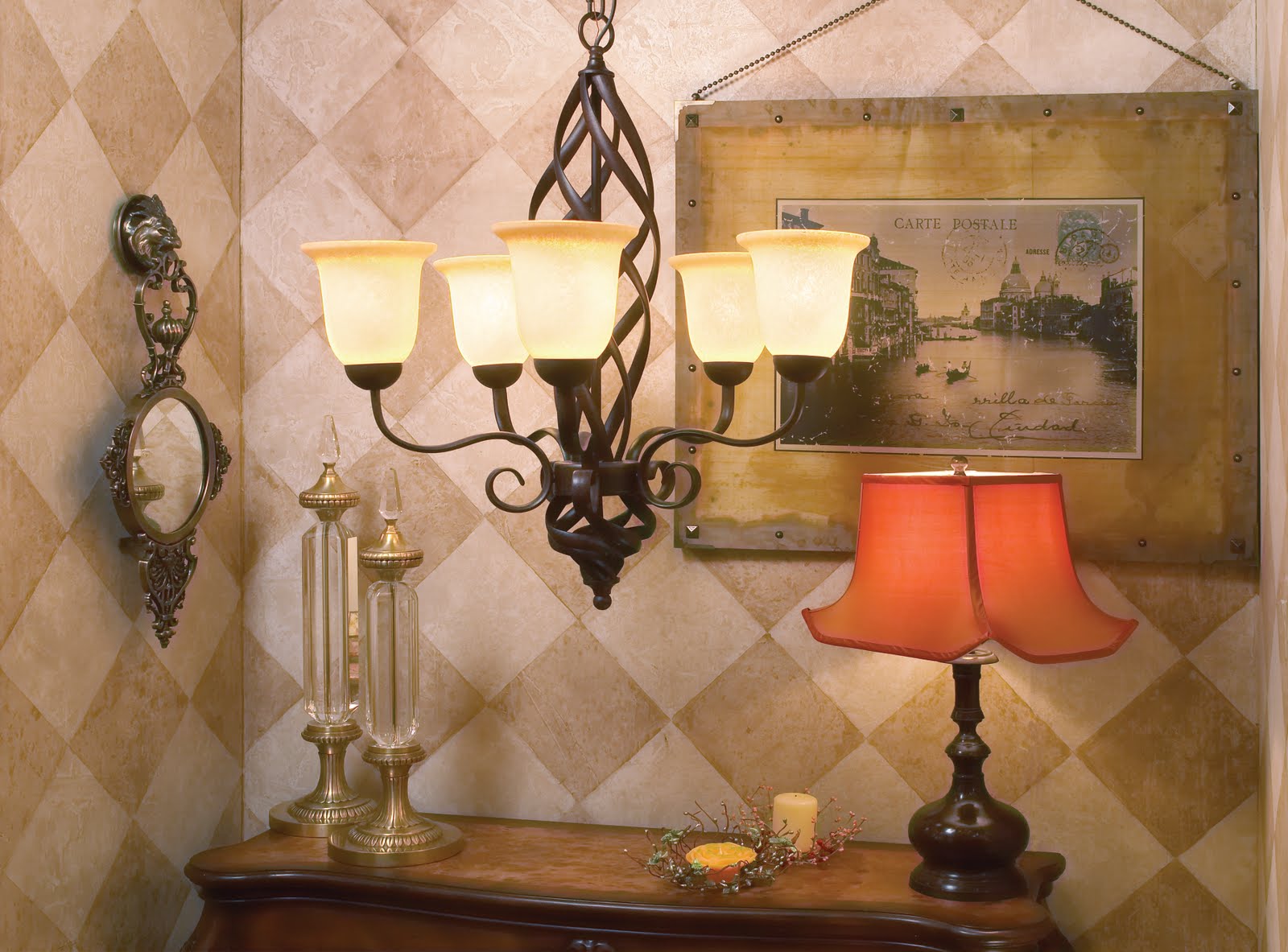
Check here often for tips on selecting the right lighting for your home, the correct placement, and how to care for your lighting. This can be anything from where to hang a chandelier to how to properly utilize accent lighting to spark a unique and "illuminating" room design.
Monday, May 2, 2011
Lighting One's 10th Anniversary Featured

Friday, April 8, 2011
How Do You Light Small Spaces?
Thursday, October 21, 2010
Where to Use CFLs (Compact Fluorescent Lights)

Creating an indoor lighting plan usually takes three major factors into consideration: General illumination/ ambient lighting gives a space an overall lighted appearance. Task lighting specifically places light in desired areas to perform work or read. Dramatic/decorative lighting creates mood and adds interest to interior design. Often, outdoor lighting represents a fourth consideration to an entire lighting plan. Energy-efficient CFLs are made in a variety of styles to fit practically every incandescent equivalent currently being used. Many CFLs are offered in dimmable and three-way 
versions, which allow the user greater control of the lamp’s light output. When working with CFLs, it is recommended that you assess the lamp’s abilities for the given application. Wednesday, September 8, 2010
Yosemite in Lighting One Showrooms
Lighting One recently joined with Yosemite Home Decor to have their products in selected Lighting One showrooms throughout the country. Located in the Central Valley of Fresno, California, Yosemite Home Decor has set out to become the premier leader in lighting and other home products. The extraordinary beauty and unsurpassed quality of the Yosemite line is guaranteed to transform any home's decor into a one-of-a-kind masterpiece.Monday, August 16, 2010
Upcoming Home Lighting Trends Seen at Market

The focus appeared to be on lighter colors and softer metals. Polished Nickel also stood out among the sea of fixtures. The incorporation of shades in both fabric and metal was observes in a majority of showrooms. Fixtures accented with crystal, along with colored and clear beads were very popular.
Spheres and globes, and more non-traditional shapes were also apparent.
LED Lighting continues to be the hot topic and many suppliers presented limited introductions due to the rapidly changing technology, although suppliers like Satco, one of Lighting One’s preferred partners, introduced a very large assortment of LED bulbs.
Basic entry level price points in both the traditional and contemporary categories were evident to help consumers find better values without being driven to Home Centers for their lighting needs.
Promotional products such as Tiffany lamps at Quoizel, another Lighting One preferred partner, were also featured.
So, to stay ahead of the trends and be in the know, be sure your lighting needs are fulfilled with lighting experts at any of our family-owned lighting showrooms throughout the country. To find the nearest location to you, visit www.lighting-one.com.
The image shown is Lighting One’s #30312-PW two light sconce with crystal drops, as an example of the crystal beading and metallic finishes that are very popular.
Friday, October 16, 2009
Spruce up Your Home for the Holidays!

You have your family coming in for the holidays and you would LOVE to redo your entire home before-hand... but who can afford it these days? Well, there are a few things that you can do to give your home a whole new look without having to take a second mortgage!
Placing a few new lamps around the house can provide a fresh look for your home, while providing much needed lighting for reading, homework, or projects. This additional splash of light will also brighten your home and make it feel more inviting. OR use these new lamps and turn off the overhead lights for an intimate ambiance.
Strategically placed under-cabinet lighting in your kitchen will not only provide better lighting for your workspace, but also provide your kitchen with an updated look, accent your beautiful counters, and add another layer of invitation to your already welcoming kitchen.
While we are in the kitchen, let's take a look at the lighting over your island. Placing a few art-glass mini-pendants over your island will give your entire kitchen a lift and a modern look. Or install an island light for a dual purpose fixture, that will also allow you to showcase your cookware and keep it in a handy place.
Replacing your dining room chandelier can instantly dress up your dining room. Find one that complements your style, whether traditional, modern, casual, elegant, or even eclectic. Add a few sconces on the wall to complement the chandelier, add another layer of lighting, and provide further decoration for the room.
Let's not forget the bathrooms! Sconces to either side of your vanity mirror will not only provide a high-end look for your bathroom, but your make up will thank you as you will see a more natural look with no harsh shadows. Adding a crystal mini-chandelier in your bathroom is a trendy new way to create an elegant up-lift or to enhance your shabby chic feeling.
While you are redecorating, add a few lamps in your bedrooms - reading lamps for homework spaces, torchieres for seating areas, swing arm lamps above the bed for reading, or table lamps for the side tables.
Think ceiling fans are only for the summer? Not so! Ceiling fans can be used all year around. Simply reverse the airflow and your ceiling fan will circulate the heat throughout the room and keep your room from feeling too stuffy. Not only will it help your energy savings (by better distributing the air) but also, if you buy one this time of year, chances are pretty good you can find them on sale!
So, don't spend a fortune redecorating your home. Pick a few of these tips (or even all of them) and you will find yourself with a drastic change in your home for much less than remodeling!
For more design tips, contact your local lighting design specialist. To find a showroom near you, visit www.lighting-one.com.
The product shown in the picture is 0411-RD and is available at participating Lighting One showrooms.

Tuesday, September 29, 2009
The Color of Lighting
We tend to think of midday sunlight as the standard for pure white light. However when daylight is passed through a prism, the visible light is actually rendered as equal parts of a continuous spectrum. This spectrum is taught to schoolchildren by the name ROY G. BIV. Each letter standing for the visible colors produced by white light in the order it appears across the spectrum, Red, Orange Yellow, Green, Blue, Indigo, and Violet. In contrast, artificial light sources give off varying amounts of these colors. Incandescent light includes most of the spectrum but has a large proportion of red and yellow. When dimmed, incandescent light will become more orange in color. Many people think of fluorescent light as being high in green and blue, but today fluorescent bulbs come in over 200 colors.
Halogen lights produce a brighter, “whiter” light, than both standard incandescent and fluorescent light sources. Because of this brighter, white light, halogens have become very popular for both commercial and residential lighting.
Color temperatures as measured in degrees Kelvin (K) are used to formally rate light bulbs. Temperatures below 3,500 degrees K are warm-toned, more yellow in color; while higher temperatures are increasingly cool, or blue in color.
| Color Temperatures | ||
| Approximate | | Light |
| 6300° | | Daylight Fluorescent |
| 5500° | | Natural Summer Sunlight |
| 4100° | | Deluxe Cool Fluorescent |
| 3000° | | Deluxe Warm White Fluorescent |
| 2900° | | Quartz Halogen |
| 2800° | | 100 Watt Incandescent |
| 2600° | | “Incandescent” Fluorescent |
| 2500° | | 40 Watt Incandescent |
| 1800° | | Candlelight |
For more information on color, or anything about Lighting, visit a lighting expert at your local Lighting One showroom.
The product shown is 1469-ET and is available at Lighting One showrooms.
To find your closest showroom, or to view some of the products available for sale on our website, visit www.lighting-one.com.
Monday, May 18, 2009
Ambient Lighting for Your Home Decor
Ambient lighting is a term used to describe the total amount of light that is present in a space. We can say that a room has high or low levels of ambient lighting.How much lighting is needed or desired is often a very personal preference. In places such as kitchens and bathrooms, it is often good practice to provide multiple types of lighting that can provide high levels of ambient lighting for some tasks, and low levels of ambient lighting for other activities.
Places such as laundry rooms and closets are best illuminated with high levels of ambient lighting, although they also should be provided with dimming controls that allow the high ambient level to be reduced when desired. In spaces such as family rooms and bedrooms it is best to provide ambient lighting primarily from portable lamps and wall mounted lighting such as wall sconces.
Ambient lighting can also be provided by placing surface mounted fixtures at the ceiling. A recent trend is the use of decorative chandeliers in almost any space in the home. A chandelier is highly useful for providing high ambient lighting when necessary, or it can be dimmed to provide a very soft and low level of ambient lighting.
The pendants shown in the photo are from the Effervescent collection. For more information, please visit www.lighting-one.com to locate a Lighting One showroom near you. Showrooms are independently owned and operated, so product may vary from location to location.
Tuesday, February 3, 2009
E-Commerce Site Launched
We just launched our E-Commerce site for purchasing lighting online at http://www.lighting-one.com/. Please take a look and let us know of any feedback you may have.We have completely revamped our site... including now the option of buying ONLINE! Of course, you can still search for your local Lighting One showroom and visit the showroom to speak with one of our knowledgeable sales professionals who can assist in selecting that perfect fixture to complement your home decor. As we are in more than 40 states and Canada, we're sure to have a location near you!
The advantages of shopping a Lighting One showroom are GREAT PRICES with our 140+ showroom buying power; LARGER SELECTIONS featuring exclusive brands and products you won't find anywhere else; and LIGHTING DESIGN EXPERTS by Lighting One.
Lighting One showrooms are locally owned and operated and in-store merchandise may vary by location.
Monday, October 6, 2008
Task Lighting for Your Home Design
Task lighting is the lighting necessary to carry out specific activities in the home. Generally, task lighting is higher in intensity than other types of lighting. There are four primary tasks that require higher than average lighting levels.Friday, October 3, 2008
Lighting Design Trends
Lighting designers and manufacturers proudly combine fashion and function in their designs, creating compelling decorative lamps and fixtures that do more than simply illuminate – they beautify a home.Tuesday, September 23, 2008
Ask the Experts!
Question: I'm doing a kitchen update and want to use pendant lighting instead of the 6" recessed cans I currently have, but I don't want the pain of pulling the cans out of the ceiling plus doing a bunch of drywall work. Is there a way to convert a recessed can to a pendant?Answer: You can convert your existing recessed can light to a pendant by using a product called The Can Converter. This product adapts almost any recessed light fixture or can light to work with other types of light fixtures. You can modify can lights to hang a ceiling fan, ceiling light, light canopy, swag light, pendant light or just about any other type of light fixture in minutes. No patch work is required.
Question: I want to make my home more energy efficient on a small budget of a couple hundred dollars. Are dimmers a viable option for me and can I install them myself?
Answer: Dimmers are a great way to save energy with a minimal investment and are easy to install. If every US household installed only ONE more dimmer, we would reduce carbon monoxide emissions equivalent to that of 370,000 cars. Basic dimmers start at $14.99 and remote control dimmer combos start at $49.99. To install, 1. Turn power off at circuit breaker 2. Remove wall plate and switch mounting screws 3. Pull switch from wall and disconnect switch wires 4. Connect the wires in the box and dimmer by matching colors 5. Use wire connectors to secure the electrical connection. Twist wire connector tight and ensure no bare wire is exposed 6. mount and align dimmer 7. Install wall plate 8. Turn power on at circuit breaker 9. Enjoy energy savings!
Friday, September 19, 2008
How to Save Energy in Your Lighting Design
ENERGY STAR Rated Products Cuts Home Energy Use of 6,485 Watts to 1,324 Watts. By simply using ENERGY STAR® rated light fixtures, compact fluorescent bulbs and LED lights, Lighting Designer Brandi Morley dramatically cut energy use for a new model home featured in the 2008 Parade of Homes built by Stoner Homes at 849 Vista Grande from an estimated 6,485 watts to a an incredibly low 1,324 watts.If every household in the U.S. changed out just one light to an ENERGY STAR® version, we would save enough energy to light 7 million homes and prevent greenhouse gas emissions equal to 1 million cars according to the US Environmental Agency.
Look for the ENERGY STAR® label when shopping for light fixtures and bulbs. Lighting manufacturers are increasing the number of ENERGY STAR® lines so that you do not have to sacrifice style and design for energy savings. Talk to your lighting consultant on how to cut your energy costs.
Submitted by Jennifer Guerriero with the Light Center in Fort Collins, Colorado, a Lighting One showroom. To locate the Lighting One showroom nearest you, visit www.lighting-one.com. Lighting One is an ENERGY STAR® Partner.
Tuesday, September 16, 2008
Lighting for Your Bathroom and Vanity
Bath and vanity lights provide task and general lighting. Vanity lighting comes in a variety of styles and offer different numbers of lighting units. These fixtures usually use incandescent bulbs to provide task lighting for applying makeup, shaving, and grooming, but they also provide good general lighting for the entire room.Note: To reduce shadows, the best lighting for your bathroom mirror is a combination of light both above and on either side of the mirror. The second choice would be to have lighting only on each side of the mirror (as shown here). The third option, but still a good option, is to have lighting only above the mirror.
Monday, August 25, 2008
Expert Advice & Tips on all of your Home Design Needs
As a reader of the Lighting One Design Tips, you have the opportunity to become a member of one of our new partners... the most exciting new social media site for home design!Zabitatz.com has created a fun, interactive website platform where you can see, source, and share advice, insight and inspiration on home design. Through aggregating the insight of its members (aka Zabbers), Zabitatz.com allows the pizzazz - energy, vitality, style & flair - of fabulous home design to emerge.
Lighting One will be offering expert advice and tips on http://www.zabitatz.com/ as well as answering your lighting questions. Be sure to check out our sponsored group "Let the Light Shine In." We would love for you join this group. Feel free to add "Lighting One" as your friend.
See you on Zabitatz.com!
Thursday, August 14, 2008
Let Your Lighting Bathe Your Bathroom
The key lighting issue in the bath area is at the mirror to provide shadow-free lighting on the face. One fixture mounted over the mirror is a good way of lighting the bathroom, but this can still cause shadows on the face. The best way to eliminate these shadows is to add wall fixtures to the side of the mirror.If the fixture uses exposed lamps, do not use wattage higher than 40 watts. For fixtures with a clear or well-diffused glass globe use no more than 60 watts. Etched or white glass on a fixture should be used with no more than 100 watts. Color corrected fluorescent lamps should be used when fluorescent fixtures are desired.
Areas over 100 square feet require several recessed down lights or decorative surface mounted fixtures. Adding companion – close to ceiling mounted fixtures will help to supplement bath wall fixtures in these larger bathrooms.
In the shower, the use of a recessed shower light or a ceiling mounted plastic unit is appropriate. And don't forget the area over the commode. Here a recessed unit is always a welcome addition.
Finally, remember that a Ground Fault Circuit Interrupter (GFCI) should be used to protect the homeowner with any lighting fixture within the reach of water. Multiple light sources and multiple controls will allow you to alternate between morning efficiency and nighttime serenity.
No matter what your lighting needs are for your Master Bath, a Lighting One showroom should be able to assist you and provide your more Lighting Design Tips. Visit www.lighting-one.com for your nearest showroom.
Friday, August 8, 2008
Mastering the Lighting in Your Master Suite
With today’s open master suites, the master bedroom has taken on a whole new dimension in the home. Decorative sconces, torcheres, portable lamps, or built in cove lighting can provide glare free fill light. If replacing a ceiling globe in the middle of the room, consider an opaque pendant that directs the light up and off the ceiling, unless the fixture is a light unit for a ceiling fan. (When a fixture is attached to a ceiling fan the light should not be directed upward as it creates a very annoying strobe effect when the fan is on.)Where we have a master bedroom with an adjacent sitting area, more lighting will be required. Recessed lighting is one of the preferred ways to light a general area because the light source is concealed. The room will come alive through accenting artwork, wall washing or grazing. Another way to accent the room is through wall sconces.
Finally consider adding a few control switches near the bed so lights and nightlights can be controlled without getting out of bed.
Monday, August 4, 2008
The Latest Trends In Recessed Lighting
Homeowners are finding the most popular way of lighting their new kitchen or extension is with recessed lighting. That's because recessed lighting has a clean appearance and gives off plenty of light. While it's true that recessed is an excellent choice, the type of recessed lighting you choose is very important. Many people allow their contractors or electricians to select their recessed lighting. However, they usually use builder-grade recessed cans, which use 120-volt bulbs and are very expensive to run, and they don't often choose the best layout for your space.When you take into account the high cost of energy, it becomes clear that the cost of running recessed lights is more important than the cost of the lights. An excellent choice for most applications is energy-efficient 12-volt low-voltage recessed lights. These provide good quality white light without heat, cost little to run, and use long-lasting bulbs. In addition, they are smaller than traditional recessed lights, making them more attractive.
For adding new recessed lighting, a great combination would be to use American-made low-voltage recessed cans, along with high-quality European 12-volt bulbs. An added benefit of the American-made cans is that there is a 10-year warranty on both the transformer and the socket. In addition, the American-made transformers use a lower voltage compared to builder quality recessed lighting. This combination can save over $1,600 over the life of each bulb, which can last over 14,000 hours. These units give off the best quality white light, and there's no heat under the bulbs. Their smaller size, along with their great light output, make these the best choice for most homeowners.
For existing recessed lighting, there are several ways that you can save energy. The easiest would be to use European 120-volt halogen bulbs, which give off better quality light, last longer, and cut down on heat compared to traditional incandescent bulbs. These bulbs, which cost $10-$13 each, will outlast 3-4 incandescent bulbs and can save over $120 over the life of each bulb.
Another good choice for saving energy with existing recessed lighting is LED lighting. These units, which use the latest technology, easily screw into your existing recessed cans. While the initial cost of approximately $125 per unit may seem expensive, they more than make up for through the money saved on energy costs. These units use only 12 watts of energy, which is just a little more than a night-light, but they give off the same light as a 120-volt incandescent bulb. The LED units are rated for 50,000 hours of use, so based on an average of four hours of use per day, they will last 40 years. At today's energy costs, these units will save over $2,500 in energy costs and over $300 in bulb replacement costs. The units are also airtight, so they won't allow heat to escape through them. This saves even more money on heating costs.
Recently people have been touting compact fluorescent lamps (CFLs) as a good way to save energy. While it's true that they are great in terms of energy usage, they take a long time to reach their full brightness, and give off a duller light than other bulbs. In addition, homeowners must be aware that these units contain Mercury, so they must be disposed of properly. Still, fluorescent bulbs can be a very good choice in areas where the quality of light isn't as important, like in a basement or laundry room.
Written by Philip Finkelstein.Philip is a Lighting One-certified lighting designer, and has owned Illuminations in Rockville Centre, NY for the past 30 years. To locate the Lighting One showroom nearest you, visit http://www.lighting-one.com/.
Thursday, July 31, 2008
Lighting for Your Great Room
Living spaces provide prime opportunities for multi-layer lighting schemes to enhance room ambiance, dramatize wall textures, accent artwork or just provide general illumination in the den, living room, family room, playroom, or bedrooms.Recessed lighting is one of the preferred ways to light a general area because the light source is concealed. But close to ceiling or decorative fluorescent fixtures can also provide great general lighting.
For accenting artwork, wall washing or grazing, recessed or track fixtures can bring life to a room. Further, low voltage strip lighting helps create drama in bookcases.
Thursday, July 24, 2008
Extend the Enjoyment of your Landscape Lighting
Your home is the single biggest investment you'll ever make. Your home is your castle and your yard is your domain. But for a good part of the year by the time you get home from work your yard is dark. You can't see the landscaping at all, and the house just fades into the night. More and more people are finding that architectural and landscape lighting allows them to extend the enjoyment of their landscape investment into the evening hours. The right lighting creates a warm and welcoming atmosphere for the exterior of your home and your yard. You'll even enjoy the lighting from inside.You can enhance the ambiance of your property at night with low-voltage landscape lighting of trees, shrubs and flowers. You can also increase safety by lighting up stairs, driveways and walkways.
Just like the new low-voltage recessed lighting that many homeowners are using inside their homes to save money as energy costs rise, low voltage landscape lighting is available for outdoors, that uses only 12 volts of electricity. This type of lighting is energy efficient, safe to install, and offers better control of light than 120 Volt builders style lighting.
A certified Lighting One designer can easily create a lighting plan by choosing one or two points of interest and making these the centerpiece of your landscape lighting display, and then building the rest of your lighting plan around your focal points. Unique landscape features, such as sculptures and shaped shrubbery, can be highlighted using spotlights, or a sequence of spotlights can create an interesting mosaic of colors and textures. In addition, up lighting adds visual interest to objects such as trees, bushes, statues and fountains.
Other techniques include the use of path lighting to illuminate the areas where people walk or drive, which adds safety as well as beauty. Floodlighting is also a versatile technique used for illuminating a wide range of features including walls, garden ponds or gazebos.
Use silhouetting to provide dramatic effects on a broad surface, like a wall, behind a landscape feature such as bushes. Wall lighting can be incorporated into a wall that a building, pool or walkway area for added visibility.
Many homeowners let their landscaper or electrician design their landscape lighting, but these people aren't the experts in this field. For the best results and maximum energy savings, a certified lighting designer, trained by Lighting One University or the American Lighting Association, should design your landscape lighting. Whether designing landscape lighting or interior lighting, lighting designers are more familiar with the current trends in lighting and use the most energy-efficient lighting products.
Although a homeowner can easily install a small job, on a major exterior renovation a licensed electrician should be used. A well-planned landscape lighting job will encourage more use of your outdoor property and enhance the value of your home.
Written by Philip Finkelstein, a Lighting One certified lighting designer, and owner of Illuminations in Rockville Centre, NY for the past 30 years. To locate the Lighting One showroom nearest you, visit http://www.lighting-one.com/.